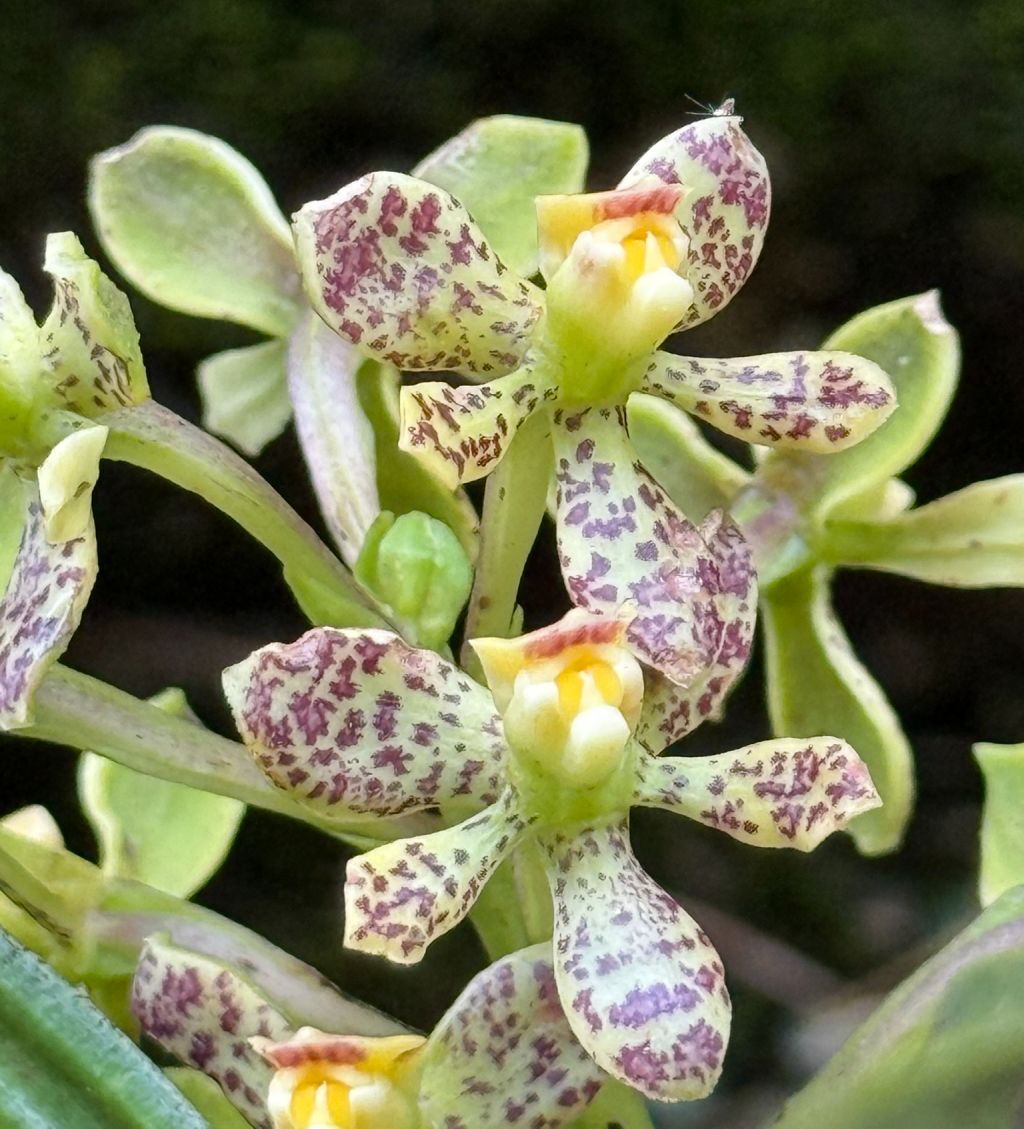
Prosthechea crassilabia [Poepp. & Endl.] Carnevali & Ramierez 2003 Vespa Complex
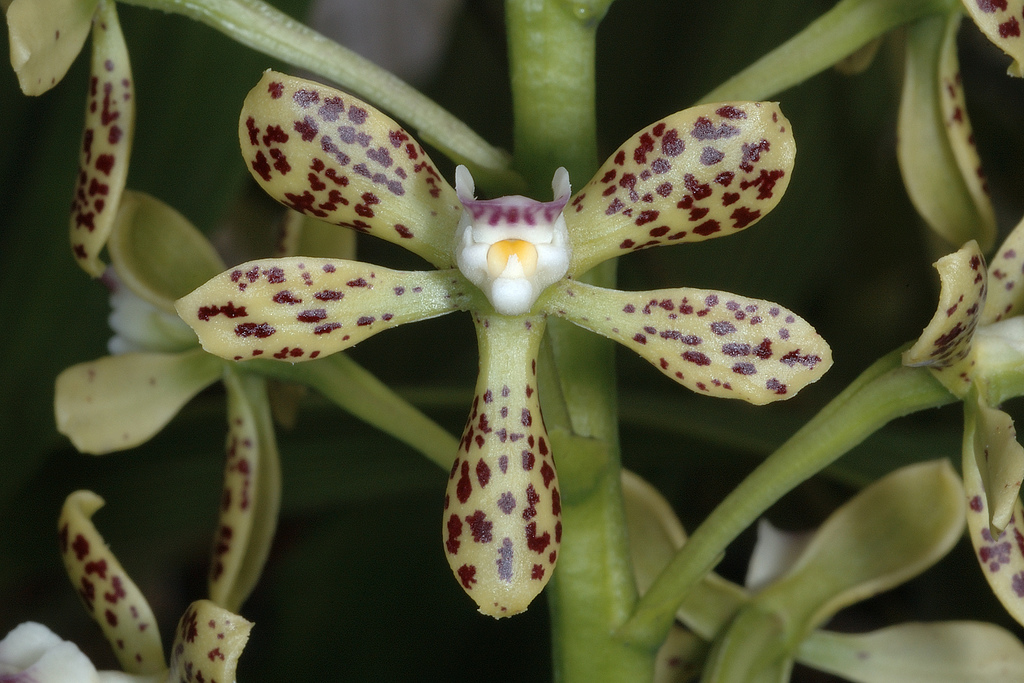
Photo in situ Zamora Chinchipe 1000 meters by © Jay Pfahl
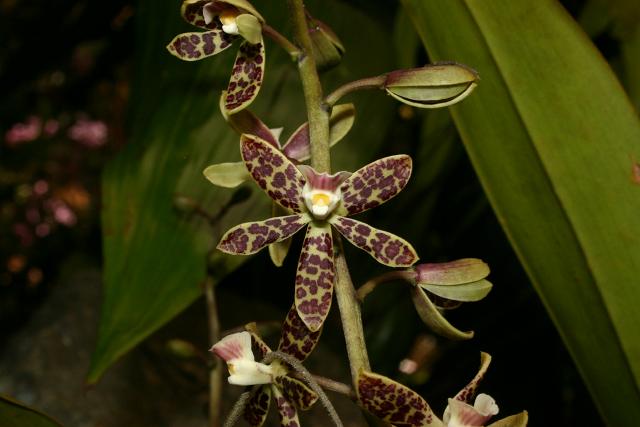
Photo by © Eric Hunt
What was considered to be Encyclia christii
Photos by Patricia Harding
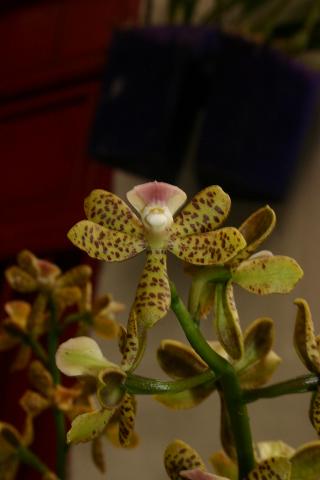
Another Color Form and flower shape
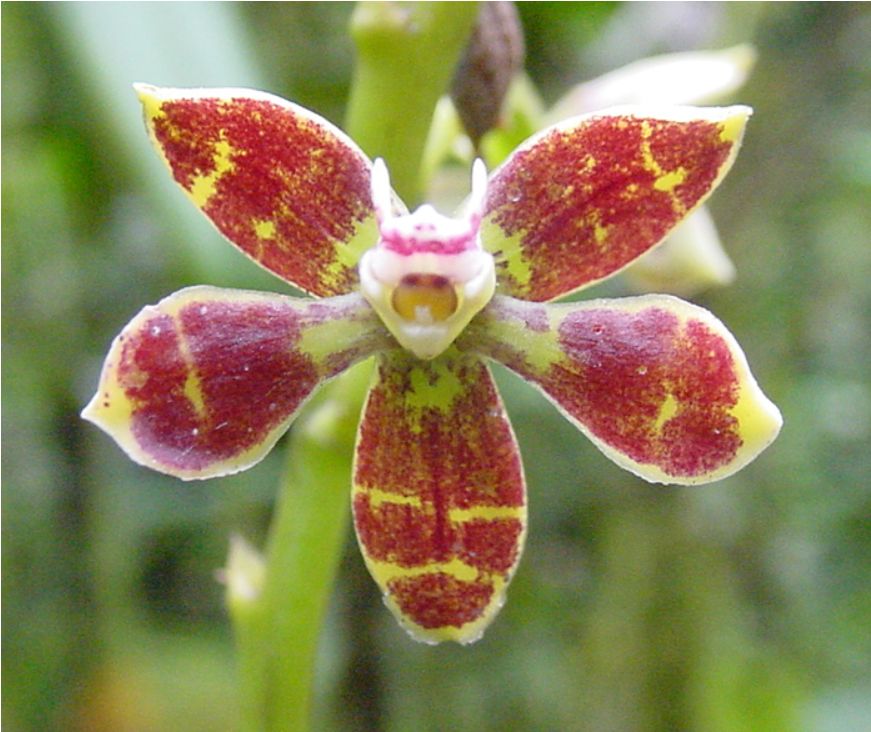
Even another flower form and color
Photos by Alexander Reynolds
Drawing by Calaway Dodson


Common Name The Thick Lipped Anacheilium
Flower Size 1.5" [3.75 cm]
Found in the Cuba, Dominican Republic, Haiti, Trinidad & Tobago, Nicaragua, Costa Rica, Panama, Colombia, Ecuador, Peru, Venezuela, Surinam, French Guyana, and Guyana at elevations of 1200 to 1900 meters as a medium sized, cool growing epiphyte, lithophyte or terrestrial in pine-oak cloud forests with clustered, large, bimorphic, ovoid, compressed or long and cylindric pseudobulbs carrying 2 to 4, erect-patent, elliptic-lanceolate to oblong-lanceolate, subacute, narrowing below into the base leaves that blooms in the spring, summmer and fall on a terminal, 12" [30 cm] long, racemose, few to many [5 to 22] flowered inflorescence arising on a newly matured pseudobulb with non-resupinate, fleshy, rigid, color variable flowers.
There is a convoluted history here and much still needs to be determined but much of what was once called Encyclia vespa is now Anacheilium crassilabia and all that is left in the new determination of Anacheilium vespa is the one found in Brazil.
Synonyms Anacheilium crassilabium [Poep. & Endl.] Withner, Harding & Campacci 2004; Auliza wilsoni Gale' 1938; Aulizeum variegatum [Hkr.] Lindley ex Stein 1892; Encyclia christii (Rchb. f.) Dodson 1994; Encyclia crassilabia (Poepp. & Endl.) Lemee' 1955; Encyclia crassilabia (Poepp. & Endl.) Dressler 1961; Encyclia feddeana (Kraenzl.) ined ?; Encyclia leopardina [Rchb.f] Dod. & Hags. 1994; Encyclia longipes (Rchb. f.) Dodson ?; Epidendrum baculibulbum Schltr. 1923; Epidendrum christii Rchb. f. 1877; Epidendrum coriaceum H. Focke 1853; Epidendrum coriaceum Parker ex Hkr. 1837; *Epidendrum crassilabium Poepp. & Endl. 1838; Epidendrum feddeanum Kraenzl. 1905; Epidendrum fuertesii Cogn. 1912; Epidendrum longipes Rchb. f. 1878; Epidendrum rhabdobulbon Schltr. 1920; Epidendrum rhopalobulbon Schltr. 1924; Epidendrum saccharatum Kraenzl. 1908; Epidendrum variegatum var. angustipetalum Hoehne 1947; Epidendrum variegatum var. coriaceum [Parker ex Hkr.] Lindl. 1853; Epidendrum variegatum var. crassilabium (Poepp. & Endl.) Lindl. 1853; Epidendrum variegatum var. leopardianum Lindl. 1853; Epidendrum variegatum var. lineatum Rchb.f. 1856; Epidendrum variegatum var. virens Lindl. 1853; Hormidium baculibulbum (Schltr.) Brieger 1960; Hormidium coriaceum [Parker] Brieger 1960; Hormidium lineatum [Rchb.f] Brieger 1977; Hormidium virens [Lindl.] Brieger 1961; Prosthechea christii (Rchb. f.) Dodson & Hágsater 1999; Prosthechea leopardina (Rchb. f.) Dodson & Hágsater 1999; Prosthechea longipes (Rchb.f.) Chiron 2005; Prosthechea vespa subsp duartiana Chiron & Castro 2005
References W3 Tropicos, Kew Monocot list , IPNI ;
Lankester's Epidendra Website CR as Prosthechea crassilabia;
Bonplandia Rchb.f 1854 as Epidendrum variegatum;
Otia Botanica Hamburgensia Rchb.f 1878 as Epidendrum longipes;
Symbolae Antillanae Vol VI Orchidaceae Urban 1909 as Epidendrum variegatum Hkr.;
Symbolae Antillanae Vol VI Orchidaceae Cogniaux 1912 as Epidendrum fuertsii;
Die Orchideen Schlechter 1915 as Epidendrum variegatum photo ok;
Repert. Spec. Nov. Regni Veg. Beih. 7: 146 Schlechter 1920 as Epidendrum rhabdobulbon;
Repert. Spec. Nov. Regni Veg. Beih. 7: 251 Schlechter 1920 as Epidendrum rhabdobulbon;
Repert. Sp. Nov. Regni. Veg. Beih. 19: 116. Costa Rica Schlechter 1923 as E baculibulbon;
Repert. Sp. Nov. Regni. Veg. Beih. 19: 209. Costa Rica Schlechter 1923 as Epidendrum baculibulbon;
Repert. Sp. Nov. Regni. Veg. Beih. 27: 71 Colombia Schlechter 1924 as E rhabdobulbon;
Repert. Sp. Nov. Regni. Veg. Beih. 27: 72 Colombia Schlechter 1924 as Epidendrum rhopalobulbon;
Repert. Spec. Nov. Regni Veg. Beih. 35: 72 Schlechter 1925 as Epidendrum variegatum;
Repert. Spec. Nov. Regni Veg. Beih. Figuren-Atlas 57: 198 Schlechter 1929 as E rhabdobulbon drawing fide;
Ceiba Vol 5 No 1 L O Williams 1956 as Epdidendrum crassilabium;
AOS Bulletin Vol 27 No 6 1958 as Epidendrum crassilabium;
Orchids of Peru Vol 2 Fieldiana Schweinfurth 1959 as Epidendrum crassilabium;
Orchids of Peru Vol 2 Fieldiana Schweinfurth 1959 as Epidendrum feddeanum;
AOS Bulletin Vol 29 #9 1960 as Epidendrum christii photo fide;
Native Orchids of Trinidad Schultes 1960 as Epidendrum crassilabium;
AOS Bulletin Vol 30 No 5 1961 as Epidendrum crassilabium;
Venezuelan Orchids Vol 2 Dunsterville & Garay 1961 as Epidendrum vespa erroneous;
AOS Bulletin Vol 31 No 7 1962 photo as Encyclia crassilabia;
Flora de Venezuela Foldats Volumen XV Part 3 1970 as Epidendrum vespa;
Die Orchideen 3 Auflage Bd 1 Sonderabdruck aus Schlechter Lieferung 9 513 - 576 Brieger, Maatsch and Senghas 1977 as Hormidium lineatum photo fide;
Die Orchideen 3 Auflage Bd 1 Sonderabdruck aus Schlechter Lieferung 9 513 - 576 Brieger, Maatsch and Senghas 1977 as Hormidium crassilabium photo fide;
Die Orchideen 3 Auflage Bd 1 Sonderabdruck aus Schlechter Lieferung 9 513 - 576 Brieger, Maatsch and Senghas 1977 as Hormidium baculibulbon;
Die Orchideen 3 Auflage Bd 1 Sonderabdruck aus Schlechter Lieferung 9 513 - 576 Brieger, Maatsch and Senghas 1977 as Hormidium fuertesii;
Die Orchideen 3 Auflage Bd 1 Sonderabdruck aus Schlechter Lieferung 9 513 - 576 Brieger, Maatsch and Senghas 1977 as Hormidium coriaceum;
Orchids of Venezuela, An Illustrated Field Guide Vol 1 Dunsterville & Garay 1979 as Epidendrum vespa drawing ok;
Icones Planetarum Tropicarum Plate 071 Dodson 1980 as Encyclia vespa not = A crassilabium drawing fide;
Icones Planetarum Tropicarum Plate 528 Dodson 1982 as Encyclia vespa not = A crassilabia drawing fide;
Icones Planetarum Tropicarum Plate 699 Dodson 1982;
The Orchids of Surinam Werkhoven 1986 photo fide;
Orchids from The Coast Of Ecuador Arosemana, Jurado, Estrada and Konanz 1988 as Encyclia vespa photo fide;
Selbyana Vol 10 Orchids of Central America Hamer 1988 as Encyclia vespa drawing fide;
Native Colombian Orchid Vol 1 COS 1990 as Anacheilum vespa;
Orchids Travel By Air A Pictoral Safari Mulder, Mulder-Roelfsema and Schuiteman 1990 as Encyclia vespaphoto fide;
Icones Planetarum Tropicarum Plate 1429 Hagsater & Salazar 1992 as Encyclia vespa not = A crassilabium drawing fide;
AOS Bulletin Vol 62 No 8 1993 as E vespa photo fide;
Icones Orchidacearum Peruviarum Plate 039 Bennett & Christenson 1993 as Encyclia vespa not = A crassilabia drawing fide;
Orquideologia Vol 19 #2 pg 149 1994 as E christii;
Orquideologia Vol 19 #2 pg 149 1994 as E leopardiana;
Orchids of the High Mountain Atlantic Rainforest in SE Brazil Warren & Miller 1994 as Encyclia vespa;
Venezuela; Paraiso de Orquideas Romero 1997 as Encyclia vespa photo fide;
Flora of the Venezuelan Guayana Vol 7 Steyermark, Berry, Yatskievych and Holst 2003 as Prosthechea crassilabia;
Native Ecuadorian Orchids Vol 4 Dodson 2003 as Prosthechea vespa drawing/photo fide;
*The Cattleyas and Their Relatives, the Debateable Epidendrum Withner and Harding 2004 photo fide;
Orchids of Bolivia Vol II Laelinae Vasquez & Ibisch 2004 as Prosthechea vespa, drawing/photo fide;
Orchids of Cuba Llamacho & Larramendi 2005 as Protheschea vespa photo fide;
Icones Orchidacearum Brasilienses II Castro 2006 as Protheschea pachysepala;
Orquideas de la Serrania del Baudo Misas Urreta 2006 as Prosthechea vespa drawing/photo fide;
Orchid Digest Vol 73 #3 2009;
Orchid Species of Peru Zelenko & Bermudez 2009 photo fide as Prosthechea crassilabia;
Orchids of Costa Rica Vol 2 Morales 2009 as Prosthechea crassilabia photo fide;
Las Orquideas del Peru Izerskyy & Bezverhov 2011 photo fide;
Orquideas de Roirama Luz & Franco 2012 as Prosthechea vespa not = A crassilabia photo fide;
Orchids of the Department of Valle de Cauca Colombia Vol 2 Kolanowska, Hagsater etal 2014;
Orchid Genera and Species in Guatemala Archila, Szlachchetko, Chiron, Lipinska, Mystkowska and Bertolini 2018 as Prosthechea crassilabia;
Orquideas de Farallones de Cali Galindo-Tarazona, Haelterman, Zuluaga Trochez and Sebastian Moreno 2020 as Prosthechea crassilabia photo fide;
Vanishing Beauty, Native Costa Rican Orchids Vol 2 Lacaena to Pteroglossa Pupulin 2020 as Prosthechea crassilabia photo fide;
Materials to the Orchid Flora of Colombia Vol IV:378 Szlatchetko & Kolanowska 2023 as Prosthechea vespa drawing fide;
Materials to the Orchid Flora of Colombia Vol IV:381 Szlatchetko & Kolanowska 2023 as Prosthechea rhabdobulbon drawing fide;
Materials to the Orchid Flora of Colombia Vol IV:385 Szlatchetko & Kolanowska 2023 drawing fide;
Materials to the Orchid Flora of Colombia Vol IV:385 Szlatchetko & Kolanowska 2023 as P leopardina drawing fide
--------------------------------------------------------------------------------------------------------------------------