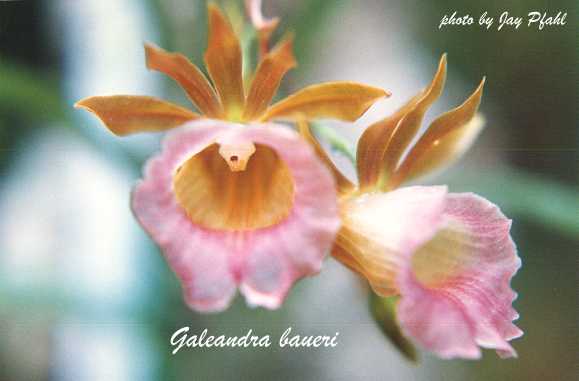
!Galeandra baueri Lindley 1832 SECTION GaleandraPhoto by © Jay Pfahl


 to
to

Common Name Bauer's Galeandra [Austrian Botanical Painter 1800's]
Flower Size 3" [7.5 cm]
This is a medium sized, warm to cool growing epiphyte found on trees in pine lands and in open forests usually on palms and found at elevations of 800 to 1200 meters in altitude. They can grow into large clumps and are only found in Colombia, Bolivia and Peru as well as Fr Guiana, Surinam and northern Brazil with closely spaced on the rhizome, fusiform, elongate, 10" [25 cm] pseudobulbs enveloped by several, imbricating, scarious sheaths with 8 or so leaves, linear-lanceolate, pointed, basally clasping, coriaceous yet flexible with prominent veining. It has an apical, curving, often branched, to 12" [30 cm] long, lax, pendulous inflorescence arising on a newly matured pseudobulb with a few long-lasting, fragrant, funnel shaped flowers that open in succession in the spring through early summer.
They need bright light and regular frequent waterings and fertilizer through the growth season but with the yellowing of the deciduous leaves in the fall it should be lessened until new growth appears in the late winter to early spring.
Very similar to the Central American G batemanii but this one is only found in South America and is a much larger plant with rounded at the base pseudobulbs and has wider sepals and petals
Synonyms Galeandra batemani Rolfe 1892; Galeandra cristata Lindley 1844; Galeandra funckiana Lindl. ex Rchb.f 1881; Galeandra funckii Lindl. ex Rchb.f. 1856
References W3 Tropicos Kew Monocot list , IPNI ; The Orchids of Mexico and Guatemala Bateman 1843 drawing fide; Die Orchideen Schlechter 1915; Atlas des Orchidees Cultivees Constantin 1920 drawing fide to the second photo ; The Orchids of Panama L.O. Williams & P Allen 1946 drawing ok; AOS Bulletin Vol 27 No 4 1958 drawing fide; Encyclopedia of Cultivated Orchids Hawkes 1965; AOS Bulletin Vol 39 No 8 1970 photo fide; Flora de Venezuela Foldats Volumen XV Part 3 1970; AOS Bulletin Vol 47 No 9 1978 drawing good; Icones Planetarum Tropicarum Plate 746 Hamer 1982 as G batemanii drawing ok; AOS Bulletin Vol 52 No 2 1983 drawing fide; Icones Planetarum Tropicarum Series II Orchids of Bolivia plate 0340 Dodson & Vasquez 1989 drawing fide; Rudolf Schlechter Die Orchideen Band 1B lieferung 23 1393 - 1456 Brieger 1990 drawing good/photo ok; Orchids Travel By Air A Pictoral Safari Mulder, Mulder-Roelfsema and Schuiteman 1990 photo fide; Icones Planetarum Tropicarum plate 1435 Atwood 1992 drawing ok; The Manual Of Cultivated Orchid Species Bechtel, Cribb & Launert 1992 drawing ok; Orchid Digest Vol 57 Vol 3 1993 as G batemanii photo fide; Guatemala Y Sus Orquideas Behar & Tinschert 1998 photo fide; Orchids of The Brazilian Central Plateau Menezes 2004; Orchid Species of Peru Zelenko Bermudez 2009 photo not = G biloba; AOS Bulletin Vol 85 #7 2016 drawing fide;
--------------------------------------------------------------------------------------------------------------------------