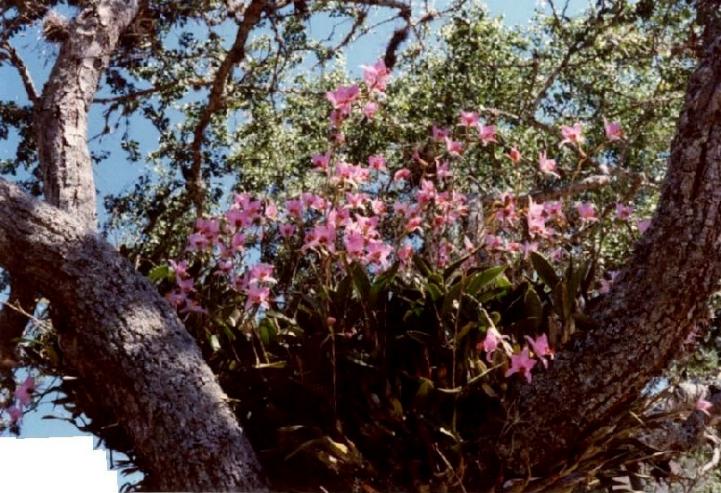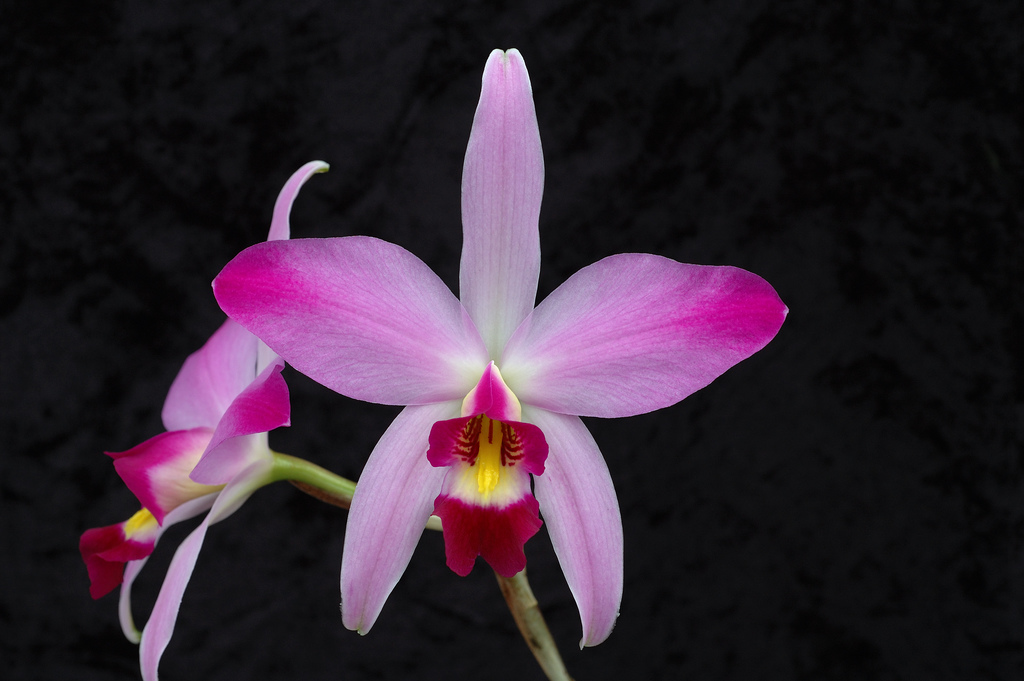
Laelia anceps Lindley 1835 SUBGENUS Laelia SECTION Podolaelia
Photo by © Eric Hunt
Photo by Weyman Bussey.
TYPE Drawing by Lindley
Laelia anceps f. alba (Rchb.f.) M.Wolff & O.Gruss 2007
Photo by Wilma Braga
Laelia anceps var. barkeriana (Knowles & Westc.) Lindl. 1837
Photo by Edwin Whitmann
Laelia anceps var. chamberlainiana Rolfe 1895
Photo by Allen Black.
Photo by Edwin Whitmann
Laelia anceps subsp. dawsonii Rolfe 1922
Photo by © Lourens Grobler
Laelia anceps var. dawsonii J. Anderson 1865 subvar. Chialapensis
Plant in situ near the town of Chilapa, Guerrero at 5000 ft elevation, exactly.
Flowers in situ same as previous
Photos by Weyman Bussey.
Laelia anceps var. hilliana Rchb.f. 1881
Photo by © Lourens Grobler
Laelia anceps var. lineata O'Brien 1895
Photo by © Lourens Grobler
Laelia anceps var. roeblingeana Rolfe 1898
Photo by © Lourens Grobler
Laelia anceps Lindley 1836 var semi-alba
Photo by Jay Pfahl
Laelia anceps var. veitchiana Rchb. f.
Photo by Patricia Harding
Laelia anceps var. vestalis Rchb.f. 1880
Photo by Eric Hunt, plant grown by Sunset Orchids.
Laelia anceps var. williamsii Sander ex Warner & B.S.Williams 1885
Photo by © Lourens Grobler


 to
to 
Common Name The Two-Edged Laelia - in Mexico El Toro
Flower Size 2.5 to 5" [6.25 to 12.5 cm]
Found in Mexico and Honduras in coffee plantations, pastures, oak and oak/pine forests with a solitary leaf in tall scattered oaks, or on rocks below them or in pastures and coffee plantations, often in full sunlight, at elevations of 500 to 1500 meters as a medium sized, warm to cool growing epiphyte with ovate-oblong, compressed, edges acute, flattened-sides, ribbed pseudobulbs carrying 1 or rarely 2, apical, oblong-lanceolate, leathery, acute leaves that blooms in the autumn to spring in on a terminal cluster, 2 to 4' [60 to 120 cm] long, alternately sheathed, 2 to 6, vanilla scented, long-lasting flowered inflorescence
This epiphytic species needs a dry winter rest.
This is a truly great hardy drought-tolerant species from eastern Mexico with fantastic flowers, L. anceps is a Christmas bloomer, angular 4" bulbs with a solitary thick dark green 8" leaf, long 2 foot spikes each with clusters of 2 to 6 flowers, the very showy 2.5" to 5" blooms are pale lavender with an intense crimson lip that has a yellow/red striped center,
Very easy to grow and does very well outdoors down to 32 degrees Fahrenheight.
Laelia anceps has been divided into 2 major groups Laelia anceps var anceps which are found on the eastern side of Mexico and L. anceps var dawsonii which are found in the western half of Mexico.
Synonyms Amalia anceps (Lindl.) Heynh. 1846 ; Amalias anceps [Lindley] Hoffmannsegg 1842; Bletia anceps [Lindley] Rchb.f 1863; Bletia anceps var. barkeriana (Lindl.) Rchb.f. 1862; Cattleya anceps [Lindley] Beer 1854; Laelia anceps f. alba (Rchb.f.) M.Wolff & O.Gruss 2007; Laelia anceps f. chilapensis Soto Arenas 1993; Laelia anceps f. dawsonii (J. Anderson) Soto Arenas 1993; Laelia anceps subsp. dawsonii Rolfe 1922; Laelia anceps subsp. hallydayana (O'Brien) Rolfe 1922; Laelia anceps subsp. sanderiana (Rchb.f.) Rolfe 1922; Laelia anceps subsp. schroederiana (Rchb.f.) Rolfe 1922; Laelia anceps var. alba Rchb.f.1887; Laelia anceps f. chilapensis Soto Arenas 1993; Laelia anceps var. amesiana O'Brien 1888; Laelia anceps var. ashworthiana O'Brien 1894; Laelia anceps var. ballantineana L.Linden1898; Laelia anceps var. barkeriana (Knowles & Westc.) Lindl. 1837; Laelia anceps var. blanda Rchb.f. 1885; Laelia anceps var. chamberlainiana Rolfe 1895; Laelia anceps var. crawshayana auct. 1895; Laelia anceps var. dawsonii J. Anderson 1865; Laelia anceps var. delicata B.S.Williams 1885; Laelia anceps var. grandiflora B.S.Williams 1888; Laelia anceps var. hilliana Rchb.f. 1881; Laelia anceps var. hollydayana O'Brien 1894;Laelia anceps var. holocheila Rolfe 1891; Laelia anceps var. hyeana L.Linden & Rodigas 1889; Laelia anceps var. kienastiana Rchb.f. 1886; Laelia anceps var. leucosticta Rchb.f. 1885; Laelia anceps var. lineata O'Brien 1895; Laelia anceps var. morada Rolfe 1922; Laelia anceps var. munda Rchb.f. 1886; Laelia anceps var. obscura Rchb.f. ex B.S.Williams 1894; Laelia anceps var. oweniana auct. 1892; Laelia anceps var. percivaliana Rchb.f. 1883; Laelia anceps var. protheroana O'Brien 1896; Laelia anceps var. radians Rchb.f. 1888; Laelia anceps var. roeblingeana Rolfe 1898; Laelia anceps var. sanderiana Rchb.f. 1887; Laelia anceps var. schroederiana Rchb.f. 1885; Laelia anceps var. scottiana Warner & B.S.Williams 1888; Laelia anceps var. simondsii Rolfe 1901; Laelia anceps var. stella Rchb.f. 1866; Laelia anceps var. superba Regel 1855; Laelia anceps var. vestalis Rchb.f. 1880; Laelia anceps var. virginalis auct. 1887; Laelia anceps var. waddoniensis J.Greg. 1898; Laelia anceps var. williamsii Sander ex Warner & B.S.Williams 1885; Laelia barkeriana Knowles & Westc. 1837; Laelia dawsoni Crawshay 1902; Laelia hollidayana (O'Brien) Crawshay 1902; Laelia mottae Archila, Chiron, Szlach. & Pérez-García 2014; Laelia sanderiana (Rchb.f.) Crawshay 1902; Laelia schroederae Crawshay 1902; Laelia schroederiana (Rchb.f.) Crawshay 1902
References W3 Tropicos, Kew Monocot list , IPNI ;
* Edwards's Bot. Reg. 21: t. 1751 Lindley 1835
Edwards's Bot. Reg. 21: t. 1751 Lindley 1835 drawing fide;
Fl. Cab. 1: 63 Knowles & Westcott 1837 as L anceps var barkeriana;
Edwards's Bot. Reg. 23: t. 1947 Lindl. 1837 as L anceps var barkeriana;
Edwards's Bot. Reg. 23: t. 1947 Lindl. 1837 as L anceps var barkeriana drawing fide
Verz. Orchid.: 20 Hoffmans 1842 as Amalia anceps
Alph. Aufz. Gew.: 29 Heynh 1846 as Amalia anceps;
Prakt. Stud. Orchid.: 208 Beer 1854 as Cattleya anceps;
Gartenflora 4: t. 140 Regel 1855 as L anceps car superba drawing fide;
Bonplandia Rchb.f 1856;
Ann. Bot. Syst. 6: 418 Rchb.f 1862 as Bletia anceps;
Xenia Orchidaceae vol 2: 47 Rchb.f 1862 as Bletia anceps var barkeriana;
Gard. Chron. 1868: 27 J Anderson 1868 as L anceps var dawsonii;
L'orchidophile; Traité Théor. & Prat.: 355 F Buyss 1878
L'orchidophile; Traité Théor. & Prat.: 355 F Buyss 1878 as L anceps var delicata;
Gard. Chron., n.s., 13: 136 Rchb.f 1880 as L anceps var vestalis;
Gard. Chron., n.s., 15: 169 Rchb.f 1881 as L anceps var hilliana;
Gard. Chron., n.s., 19: 110 Rchb.f 1883 as L anceps var percivalana;
Gard. Chron., n.s., 23: 206 Rchb.f 1885 as L anceps var blanda;
Gard. Chron., n.s., 23: 206 Rchb.f 1885 as L anceps var leucosticta;
Gard. Chron., n.s., 23: 342 Rchb.f 1885 as L anceps var schroederiana;
Orchid Album 4: t. 190 Sander ex Warner & B S Williams 1885 as L anceps var williamsii;
Orchid Album 4: t. 190 Sander ex Warner & B S Williams 1885 as L anceps var williamsii drawing fide;
Gard. Chron., n.s., 25: 298 Rchb.f 1886 as L anceps var kienastiana;
Gard. Chron., n.s., 25: 298 Rchb.f 1886 as L anceps var munda;
Gard. Chron., n.s., 25: 136 Rchb.f 1886 as L anceps stella;
Gard. Chron., n.s., 26: 758 G F Wilson 1886 as L anceps var virginalis;
Gard. Chron., ser. 3, 1: 484 Rchb.f 1887 as L anceps var alba;
Gard. Chron., ser. 3, 1: 280 O'Brien 1887 as L anceps var stella drawing fide;
Gard. Chron., ser. 3, 1: 280 O'Brien 1887 as L anceps var calvertiana;
Gard. Chron., ser. 3, 1: 104 Rchb.f 1887 as L anceps var sanderiana;
Gard. Chron., ser. 3, 1: 72 Rchb.f 1887 as L anceps var schroederae;
Gard. Chron., ser. 3, 1: 280 O'Brien 1887 as L anceps var veitchiana;
Gard. Chron., ser. 3, 1: 280 O'Brien 1887 as L anceps var hillii;
Gard. Chron., ser. 3, 4: 660 O'Brien 1888 as L anceps var amesiana;
Gard. Chron., ser. 3, 3: 105 B S Williams 1888 as L anceps var grandiflora drawing fide;
Gard. Chron., ser. 3, 3: 200 Rchb.f 1888 as L anceps var radians;
Orchid Album 7: t. 325 Warner & B S Williams 1888 as L anceps var scottiana;
Orchid Album 7: t. 325 Warner & B S Williams 1888 as L anceps var scottiana drawing fide;
Lindenia 5: t. 226 L Linden & Rodigas 1889 as L anceps var hyeana;
Lindenia 5: t. 226 L Linden & Rodigas 1889 as L anceps var hyeana drawing fide;
Gard. Chron., ser. 3, 9: 426 Rolfe 1891 as L anceps var holocheila;
J. Hort. Cottage Gard., ser. 3, 25: 569 R Hogg 1892 as L anceps var oweniana drawing fide;
Gard. Chron., ser. 3, 15: 103 O'Brien 1894 as L anceps var ashworthiana drawing fide;
Orch.-Grow. Man., ed. 7: 430 Rchb.f ex B S Williams 1894 as L anceps var obscura;
Orchid Rev. 2: 74 O'Brien 1894 as L anceps var holidayana;
Orchid Rev. 3: 1 Rolfe 1895 as L anceps var chamberlainiana;
J. Hort. Cottage Gard., ser. 3, 30: 67 R Hogg 1895 as L anceps var crawshayana drawing fide;
Gard. Chron., ser. 3, 18: 734 O'Brien 1895 as L anceps var lineata;
Orchid Rev. 3: 34 Rolfe 1895 as L anceps var rosefieldensis;
Gard. Chron., ser. 3, 19: 40 O'Brien 1896 as L anceps var protheroana;
Orchid Rev. 6: 40 Rolfe 1898 as L anceps var roeblingiana;
Lindenia 14: t. 632 L Linden 1898 as L anceps var ballantineana;
Gard. World 14: 396 Crowley 1898 as L anceps var waddoiensis;
Gard. Chron., ser. 3, 23: 124 Mast. 1898 as L anceps f waddoensis;
Orchid Rev. 9: 50 Rolfe 1901 as L anceps var simondsii;
Gard. Chron., ser. 3, 32: 414 Crawshay 1902 as L dawsonii;
Gard. Chron., ser. 3, 32: 414 Crawshay 1902 as L hollidayana;
Gard. Chron., ser. 3, 32: 414 Crawshay 1902 as L sanderiana;
Gard. Chron., ser. 3, 32: 414 Crawshay 1902 as L schroederae;
Gard. Chron., ser. 3, 32: 414 Crawshay 1902 as L schroederiana;
Die Orchideen Schlechter 1915;
Die Orchideen Schlechter 1915 as L anceps var alba;
Die Orchideen Schlechter 1915 as L anceps var delicata;
Die Orchideen Schlechter 1915 L anceps var sanderiana;
Atlas des Orchidees Cultivees Constantin 1920 drawing fide;
Orchid Rev. 30: 10 Rolfe 1922 as L anceps var morada;
Orchid Rev. 30: 10 Rolfe 1922 as L anceps subsp hollidayana;
Orchid Rev. 30: 10 Rolfe 1922 as L anceps subsp dawsonii;
Orchid Rev. 30: 10 Rolfe 1922 as L anceps subsp sanderiana;
Orchid Rev. 30: 10 Rolfe 1922 as L anceps subsp schroederiana;
AOS Bulletin Vol 15 # 7 1946 as L anceps var sanderiana photo fide;
AOS Bulletin Vol 26 No 2 1957 drawing fide;
AOS Bulletin Vol 27 No 9 1958 drawing ok;
AOS Bulletin Vol 30 No 9 1961;
Encyclopedia of Cultivated Orchids Hawkes 1965;
AOS Bulletin Vol 36 #10 1967 drawing fide;
AOS Bulletin Vol 38 No 7 1969;
AOS Bulletin Vol 39 No 5 1970 as L anceps var coerulea;
Die Orchideen 3 Auflage Bd 1 Sonderabdruck aus Schlechter Lieferung 10 576 - 632 Brieger, Maatsch and Senghas 1977;
AOS Bulletin Vol 49 No 5 1979;
Orquídea (Mexico City), n.s., 7[3]: 1979;
AOS Bulletin Vol 50 No 5 1981 as L anceps var. barkeriana drawing fide;
AOS Bulletin Vol 50 No 5 1981 as L anceps stella drawing fide;
AOS Bulletin Vol 56 #5 1987 photo fide;
AOS Bulletin Vol 56 No 5 1987 as L anceps var alba drawing fide;
AOS Bulletin Vol 56 No 5 1987 as L anceps var. barkeriana drawing fide;
AOS Bulletin Vol 56 No 5 1987 as L anceps subsp. dawsonii drawing fide;
AOS Bulletin Vol 56 No 5 1987 as L anceps var hilliana drawing fide;
AOS Bulletin Vol 56 No 5 1987 as L anceps var. veitchiana photo fide;
AOS Bulletin Vol 56 No 5 1987 as L anceps var. williamsii photo;
An Introdution to the Orchids of Mexico Wiard 1987 photo fide;
Cattleya and Their Relatives Vol 2 Withner 1990 photo fide;
AOS Bulletin Vol 61 No 9 1992 postage stamp fide;
The Manual Of Cultivated Orchid Species Bechtel, Cribb & Launert 1992 photo fide;
AOS Bulletin Vol 62 No 2 1993 photo fide;
Orquídea (Méx.) 13(1-2) 1993 drawing/photo fide;
Orquídea (Méx.) 13(1-2): 138 Soto Arenas 1993 as L anceps f chilapensis;
AOS Bulletin No 63 No 11 1994 photo fide;
Orchid Digest Vol 59 No 2 1995;
AOS Bulletin Vol 65 No 5 1996 as L anceps var. veitchiana photo fide;
AOS Bulletin Vol 66 No 12 1997 photo;
AOS Bulletin Vol 66 No 12 1997 AOS Bulletin Vol 66 No 12 1997 as L anceps var alba photo fide;
Guatemala Y Sus Orquideas Behar & Tinschert 1998 photo fide;
Laelias In Mexico ORQUIDEA (MEX.) 15. OCTOBER 1997 photo fide;
Laelias In Mexico ORQUIDEA (MEX.) 15. OCTOBER 1997 as Lanceps var. alba photo fide;
Laelias In Mexico ORQUIDEA (MEX.) 15. OCTOBER 1997 as Lanceps var. dawsonii subvar. Chialapensis drawing/ photo fide;
Australian Orchid Review Vol 65 No 5 2000 photo;
AOS Bulletin Vol 70 No 6 2001 photo fide;
AOS Bulletin Vol 71 No 6 2002 as L anceps subsp. dawsonii photo fide;
Icones Orchidacearum 5 - 6 Orchids of Mexico Part 2 - 3 Plate 597 Hagsater & Soto 2002;
Icones Orchidacearum 5 - 6 Orchids of Mexico Part 2 - 3 Plate 597 Hagsater & Soto 2002 as L anceps subsp. dawsonii drawing fide;
Australian Orchid Review Vol 69 No 4 2004 photo;
Algunas Orquideas de Oaxaca Suarez 2004 photo fide;
AOS Bulletin Vol 74 #7 2005 photo fide;
AOS Bulletin Vol 74 No 7 2005 as L anceps var. dawsonii subvar. Chialapensis photo fide;
AOS Bulletin Vol 74 No 12 2005 as L anceps var coerulea photo fide;
Australian Orchid Review Vol 71 No 4 2006 photo;
AOS Bulletin Vol 75 No 4 2006 photo fide;
Orchid Digest Vol 71 #1 2007 photo fide;
Orchid. Atlas: 178 M Wolff & O Gruss 2007 as L anceps f alba;
AOS Bulletin Vol 77 #7 2008 photo fide;
AOS Bulletin Vol 77 No 11 2008 photo fide;
AOS Bulletin Vol 77 No 12 2008 photo fide;
AOS Bulletin Vol 77 No 12 2008 as L anceps var. dawsonii subvar. Chialapensis photo;
AOS Bulletin Vol 77 No 12 2008 as L anceps var. veitchiana photo;
Australian Orchid Review Vol 73 No 4 2008 as L anceps var alba photo
Australian Orchid Review Vol 73 No 4 2008 as L anceps subsp. dawsonii photo;
Icones Orchidacearum fascile 10 plate 1035 Hagsater & Soto 2008 as L anceps subsp. dawsonii drawing fide;
Icones Orchidacearum fascile 10 plate 1035 Hagsater & Soto 2008 as L anceps var. dawsonii subvar. Chialapensis drawing fide
AOS Bulletin vol 78 No 10 2009 photo fide;
AOS Bulletin vol 78 No 11 2009 photo fide;
AOS Bulletin Vol 82 #2 2013 photo fide;
Guia de Orquideas de Chiapas Carlos Rommel Beutelspacher Baigts 2013 photo fide;
Bot. Sci. 92: 345 Archila, Chiron, Szlach. & Pérez-García 2014 as L mottae;
AOS Bulletin Vol 84 #6 2015 photo fide;
AOS Bulletin Vol 85 #4 2016 as L anceps var. lineata photo fide;
Taxon 65: 1258 Peraza & Carnevali 2016 as Schomburkia anceps; AOS Bulletin Vol 85 #11 2016 as L anceps var. lineata photo fide;
Taxon 65: 1259 Peraza & Carnevali 2016 as Schomburgkia mottae;
Taxon 65: 1258 Peraza & Carnevali 2016 as Schomburgkia dawsonii;
Orchid Digest Vol 80 #2 2016 photo fide;
AOS Bulletin Vol 86 # 1 2017 photo fide;
AOS Bulletin Vol 86 # 1 2017 as L anceps subsp. dawsonii photo fide;
AOS Bulletin Vol 86 # 1 2017 as L anceps var. lineata photo fide;
AOS Bulletin Vol 86 # 1 2017 as L anceps var. veitchiana photo fide
AOS Bulletin Vol 86 #2 2017 photo ok;
AOS Bulletin Vol 86 #3 2017 photo fide;
AOS Bulletin Vol 86 # 11 2017 photo fide;
AOS Bulletin Vol 87 #1 2018 as L anceps subsp. dawsonii photo fide;
Orchid Genera and Species in Guatemala Archila, Szlachchetko, Chiron, Lipinska, Mystkowska and Bertolini 2018;
Orchid Genera and Species in Guatemala Archila, Szlachchetko, Chiron, Lipinska, Mystkowska and Bertolini 2018 as L mottae;
AOS Bulletin Vol 88 #2 2019 photo fide;
AOS Bulletin Vol 88 #3 2019 photo fide;
AOS Bulletin Vol 88 #4 2019 photo fide;
AOS Bulletin Vol 88 #7 2019 photo fide;
AOS Bulletin Vol #9 2019 photo fide;
Phytotaxa 446: 91 Perez Garcia & Cetzal 2020 as L anceps f chilapensis;
--------------------------------------------------------------------------------------------------------------------------