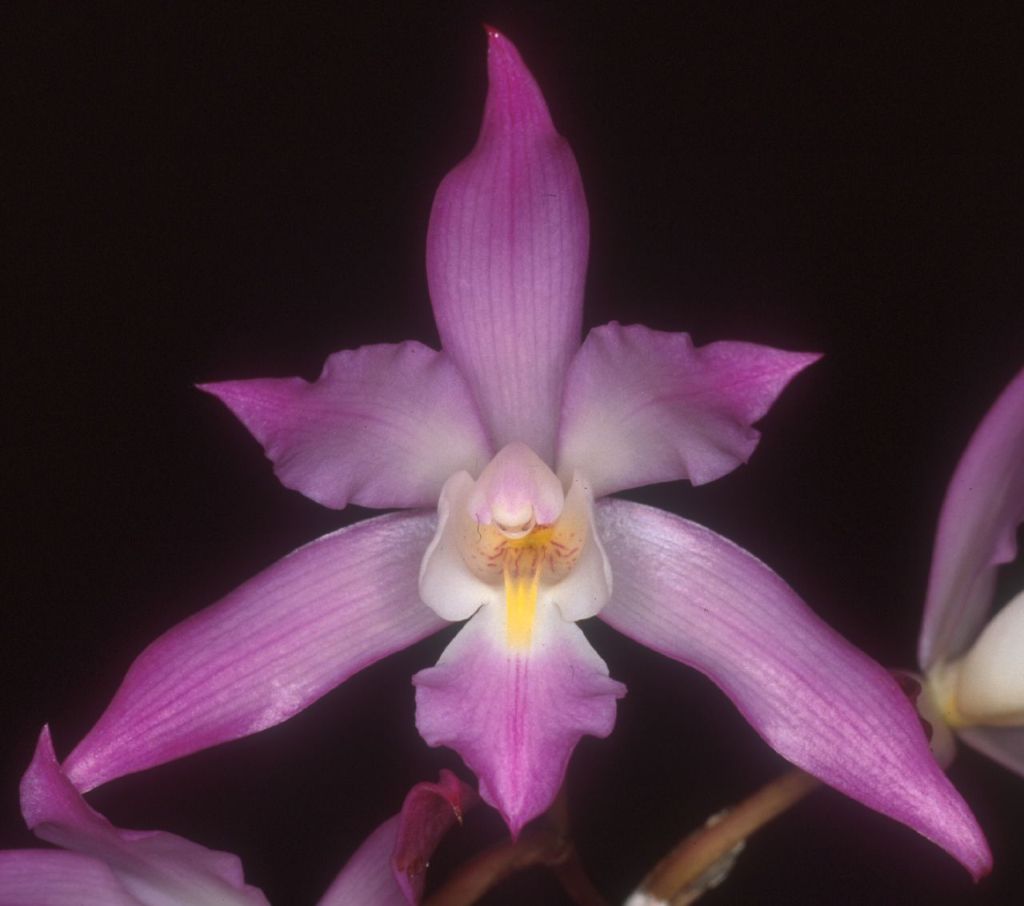
Laelia autumnalis Lindl. 1831 SUBGENUS Laelia SECTION Podolaelia Schlechter
Photo by © Lourens Grobler
Photo by Weyman Bussey
Plant and Flowers in situ as a lithophyte, central Mexico
Plant and Flowers in situ as an epiphyte, central Mexico
Photos by Edouard Faria
Drawing by Bateman
Laelia autumnalis f. atrorubens (Backh.f.) Halb. 1993
Photo by Robert Weyman Bussey
Laelia autumnalis var gouldiana Lindley 1831
Photo courtesy of Linda's Orchid Page
Laelia autumnalis var. xanthotrophis Rchb.f. 1888
Photo by Jay Pfahl
Laelia autumnalis Pink variety 1831
Photo by Robert Weyman Bussey


 and
and
Common Name The Autumn Flowering Laelia - In Mexico - Flor de los Muertos
Flower Size 3 to 4" [7.5 to 10 cm]
Found in Mexico in the central to southern mountains at elevations of 1500 to 2600 meters as a small to medium sized, cool to cold growing epiphyte or lithophyte, found on scrubby oaks and mossy rocks with bright light, a winter dormancy and night coolness with 2 to 3, leathery, lanceolate leaves per ovoid, subconical, to pyriform, tapering, curved, ridged and furrowed pseudobulbs that blooms in the fall and winter in cultivation on an erect, stout, red colored, 2 to 3' [60 to 90 cm] long, apical, covered with scale-like floral bracts, several to many flowered inflorescence with fragrant, waxy, long-lasting, color variable flowers.
L x gouldiana [a natural hybrid between L anceps and L autumnalis] and L autumnalis var gouldiana are certainly different although at first glance they appear the same. L goudiana has brighter colored flowers and a different lip shape but what sets the 2 species apart the most is the 3 calli of the lip. On L gouldiana the three calli are actually a flat, 3 striped raised plain and in L autumnalis the three calli are three raised ridge lines.
The villagers of the central highlands of Mexico on the 1st and second of November celebrate All Saint's Day and the Day of the Dead. On these days many families make small candy images of pigs, cows, horses, skulls, fruit and other familiar objects created from the pseudobulbs of this species and Laelia speciosa. It is an ancient process handed down through the generations. The pseudobulbs are sliced into thin pieces that are then ground in the same way as flour and corn for totillas. The ensuing green, mucilaginous paste is mixed with water, flour, sugar, lemon juice and egg white and then let to sit for several days. At the proper time it is poured into wooden half molds, the 2 halves are removed and pasted together and then decorated and painted with vegetable dyes to give the desired look.
Laelia autumnalis var. xanthotrophis Rchb.f. 1888
Synonyms Amalia autumnalis (Lex.) Heynh. 1846; Bletia autumnalis [Lindley]Rchb.f 1825; Cattleya autumnalis Beer 1854; Laelia autumnalis alba Rchb.f. 1889; Laelia autumnalis f. alba (Rchb.f.) M.Wolff & O.Gruss 2007; Laelia autumnalis f. atrorubens (Backh.f.) Halb. 1993; Laelia autumnalis f. xanthotrophis (Rchb.f.) Halb. & Soto Arenas 1997; Laelia autumnalis var. alba (Rchb.f.) B.S.Williams 1893; Laelia autumnalis var. atrorubens Backh.f. 1880; Laelia autumnalis var. venusta auct. 1884; Laelia autumnalis var. xanthotrophis Rchb.f. 1888; Laelia venusta Rolfe 1895
References W3 Tropicos, Kew Monocot list , IPNI ;
*Gen. Sp. Orchid. Pl.: 115 Lindley 1831
Nov. Veg. Descr. 2(Orchid. Opusc.): 19 Lex. 1825 as Bletia autumnalis;
The Orchids of Mexico and Guatemala Bateman 1843
The Orchids of Mexico and Guatemala Bateman 1843 drawing fide;
Alph. Aufz. Gew.: 29 Heynh. 1846 as Amalia autumnalis;
Prakt. Stud. Orchid.: 208 Beer 1854 as Cattleya autumnalis;
Bonplandia Rchb.f 1856;
Ann. Bot. Syst. 6: 427 Rchb.f 1862 as Bletia autumnalis;
Xenia Orchidaceae vol 2 Rchb.f 1862 as Bletia autumnalis;
Garden (London, 1871-1927) 17: 368 Backhouse 1880 as L autumnalis var atrorubens;
Garden (London, 1871-1927) 25: 366, Anon 1884 as L autumnalis var venusta;
Reichenbachiana 1: 21 Rchb.f 1888 as L autumnalis var xanthotrophis;
Gard. Chron., ser. 3, 6: 420 Rchb.f 1889 as L autumnalis alba
Orchid Album 10: t. 451 B S Williams 1893 as L autumnalis var alba
Orchid Album 10: t. 451 B S Williams 1893 as L autumnalis var alba drawing fide;
Orchid Rev. 3: 47 Rolfe 1895 as L venusta;
Die Orchideen Schlechter 1915;
Die Orchideen Schlechter 1915 as l autumnalis var alba;
Atlas des Orchidees Cultivees Constantin 1920 drawing fide;
AOS Bulletin Vol 14 # 3 1946 photo ok;
AOS Bulletin Vol 26 No 2 1957 drawing fide;
AOS Bulletin Vol 28 No 5 1959;
Encyclopedia of Cultivated Orchids Hawkes 1965;
AOS Bulletin Vol 39 No 5 1970;
Die Orchideen #6 21-24 tafel 7 Rudolph Schlechter 1971 drawing fide;
Die Orchideen 3 Auflage Bd 1 Sonderabdruck aus Schlechter Lieferung 10 576 - 632 Brieger, Maatsch and Senghas 1977 photo fide;
Orchid Digest Vol 42 No 1 1978 photo fide;
AOS Bulletin Vol 47 No 6 1978;
Flora Novo-Galaciana Vol 16 McVaugh 1985;
AOS Bulletin Vol 56 No 9 1987 photo good;
An Introdution to the Orchids of Mexico Wiard 1987 photo fide;
Cattleya and Their Relatives Vol 2 Withner 1990 photo fide;
The Manual Of Cultivated Orchid Species Bechtel, Cribb & Launert 1992 photo fide;
* Orquidea (Méx.) 13(1 - 2): 294 Halbinger. 1993 as L autumnalis f. atrorubens;
AOS Bulletin Vol 65 No 11 1996 photo fide;
Laelias In Mexico ORQUIDEA (MEX.) 15. OCTOBER 1997 photo/drawing fide;
Laelias In Mexico ORQUIDEA (MEX.) 15:95 OCTOBER 1997 as L autumnalis f. atrorubens photo fide;
Laelias In Mexico ORQUIDEA (MEX.) 15: 95 OCTOBER 1997 as L autumnalis f xanthotrophis photo fide;
Orquideas del Estado de Morelos ORQUÍDEA (MÉX.) VOLUMEN 16 NÚMERO ÚNICO enero 2002 drawing /photo fide;
Orchid. Atlas: 179 M.Wolff & O.Gruss 2007 as L autumnalis f alba;
Orchid Digest Vol 78 #1 2014 photo fide;
--------------------------------------------------------------------------------------------------------------------------


