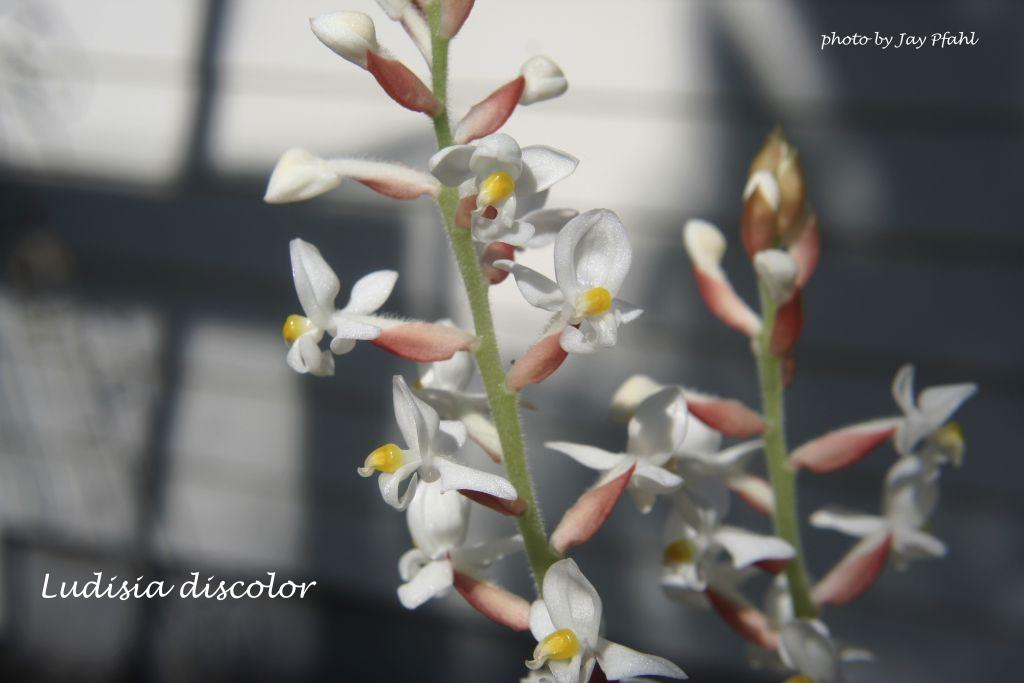
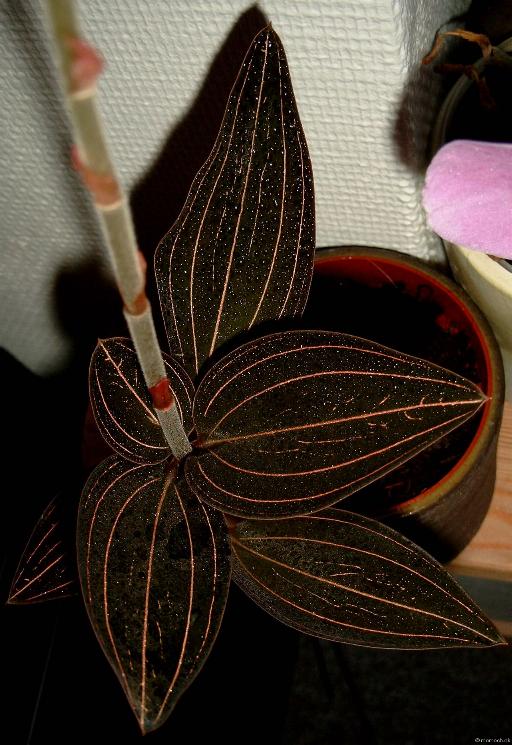
!Ludisia discolor [Ker-Gawl.] Blume 1859
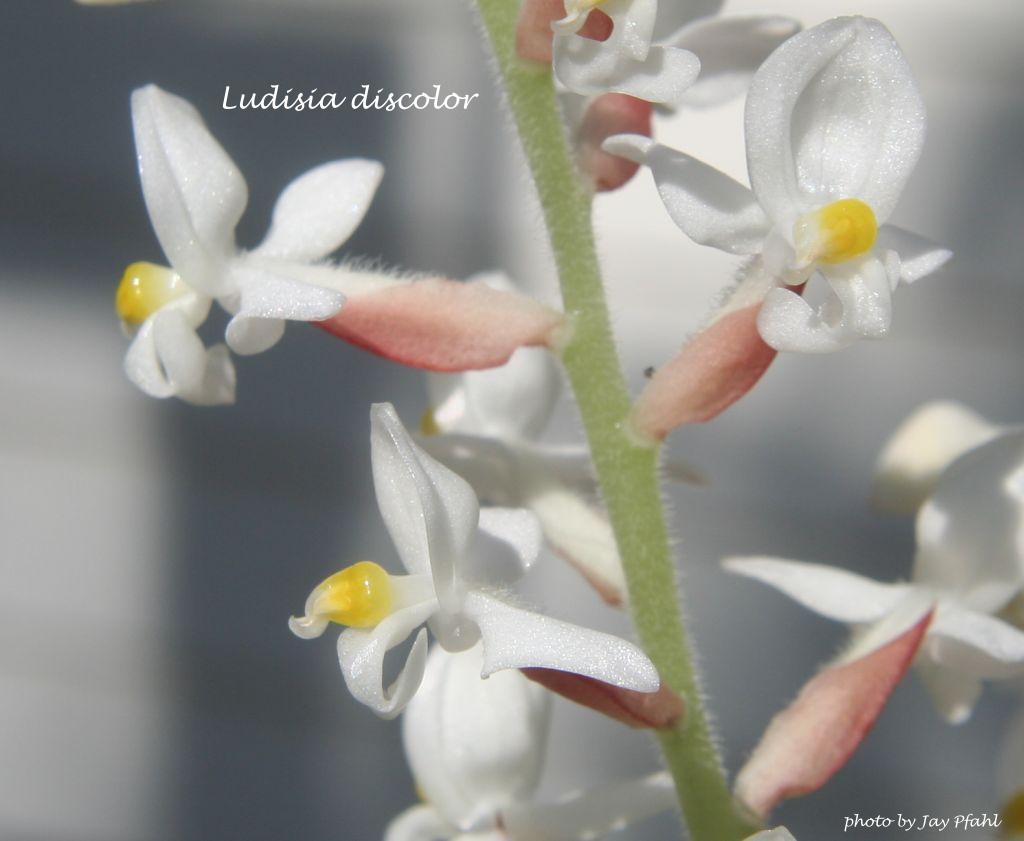
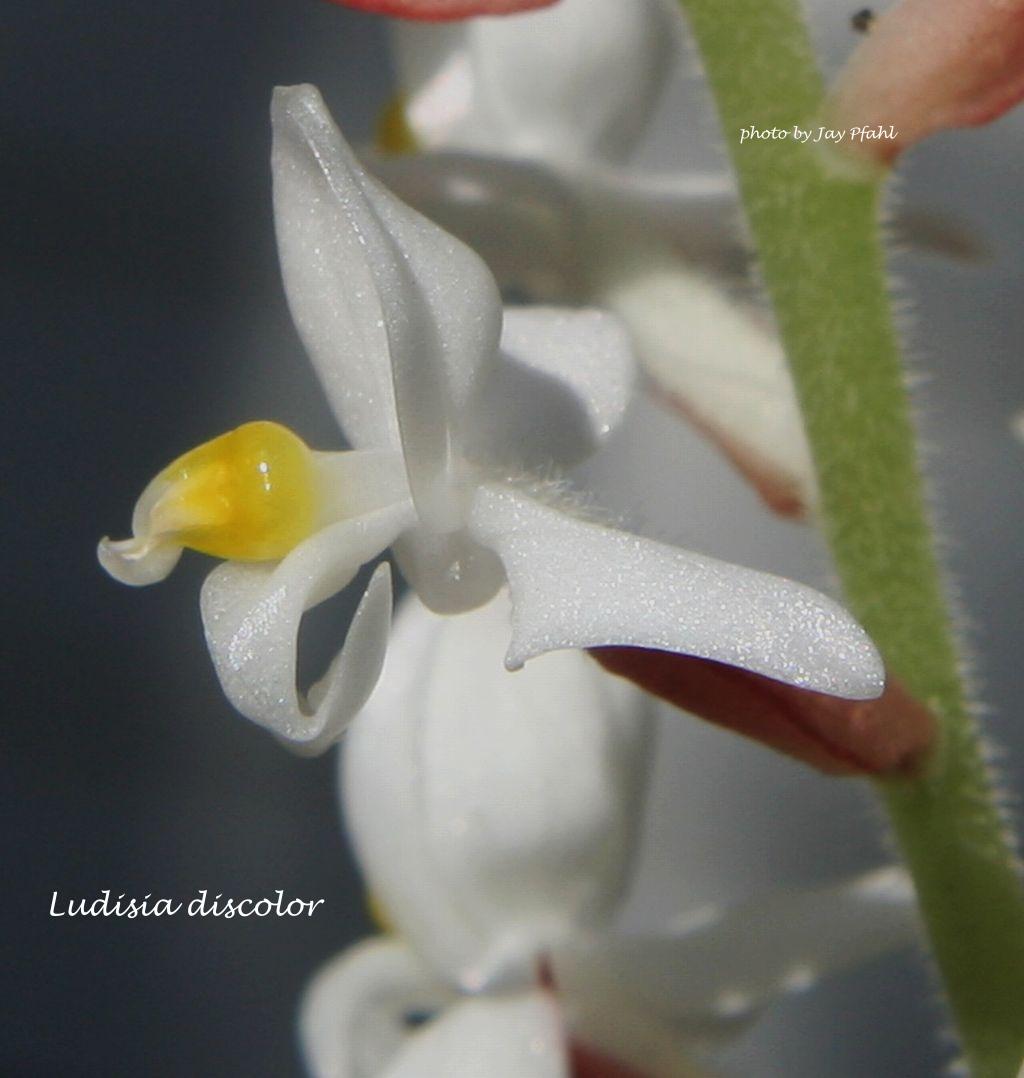
Even more closeup showing pilose sepals
Photos by © Jay Pfahl
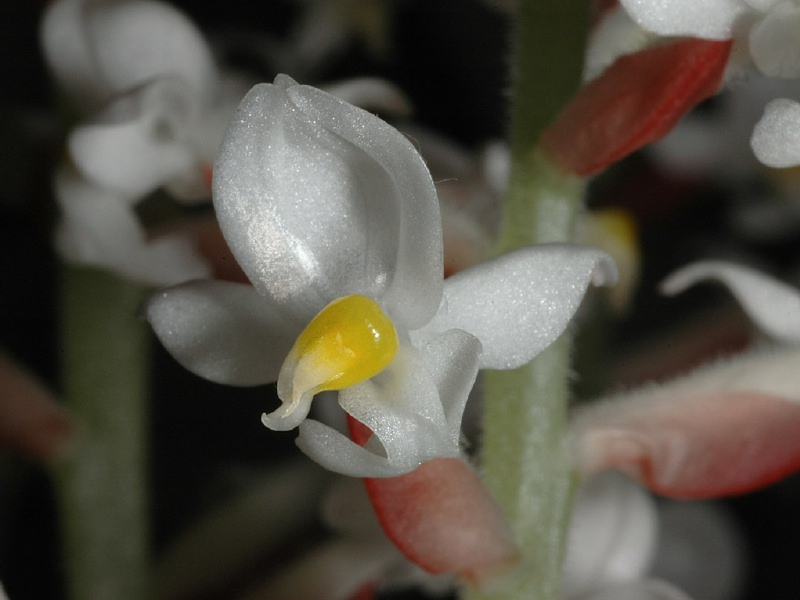
Photo by Eric Hunt
Photo by Mogens Christensen


 LATE
LATE  THROUGH
Common Name The Jewel Orchid - The Variegated Ludisia -The Twisted Flower Orchid- The Rock Silk Worn - The Rock Lotus Root- In Thailand Phak bia chang, Wan nam thong, Wan ron thong - In China Xue Ye Lan
Flower Size to 3/4" [to 1 .7 cm]
Found in China, Myanamar, Laos, Thailand, Cambodia, Vietnam, Malaysia, Sumatra, Borneo and the Philippines as a small sized, hot to warm growing 'jewel orchid', so called because of their dark green leaves criss-crossed with red lateral lines, that makes them quite appealing even when not in bloom, which is interesting but not fantastic. This species is a terrestrial or lithophytic plant occuring in evergreen, lowland forests in shady, humid habitats with rocky substrates along streams and rivers at elevations of 70 to 1100 meters without psuedobulbs, the fleshy red stems twisted, erect or pendulous are 8 to 10" [20 to 25 cm] long and have stalked elliptic-lanceolate 2 to 3" [5 to 7.5 cm] leaves and blooms in the spring on a terminal cylindrical fairly dense 4 to 12" [10 to 30 cm] long inflorescence that has small asymetrical, fragrant flowers that last 2 to 3 weeks. They can be potted with 50% potting soil and 50% tree bark, given deep shade and humid well watered conditions year round. If the leaves lose the dark green and a lot of pale red is visible they are getting too much light.
Synonyms Anoectochilus dawsonianus H.Low ex Rchb.f. 1868; Anoectochilus ordeanus Jennings 1875; Anoectochilus ordianus K.Koch 1871; Gonogona discolor Link 1822; Goodyera dawsoniana (H.Low ex Rchb.f.) W.Bull 1871; *Goodyera discolor Ker-Gawl. 1816; Goodyera ordeana (Jennings) Boxall ex Náves 1880; Goodyera ordiana B.S.Williams 1871; Goodyera rodigasciana L.Linden 1886; Goodyera rubrovenia B.S.Williams 1862; Haemaria dawsoniana (H.Low ex Rchb.f.) Hasselb. in L.H.Bailey 1915; Haemaria discolor [Ker-Gawl.]Lindley 1840; Haemaria discolor var. concolor Ridl 1896; Haemaria discolor var. condorensis Gagnep. 1934; Haemaria discolor var. dawsoniana (H.Low ex Rchb.f.) B.S.Williams 1894; Haemaria discolor var. denisoniana Kerch. 1894; Haemaria discolor var. grandis Gagnep. 1934; Haemaria discolor var. ordeana (Jennings) B.S.Williams 1894; Haemaria discolor var. rhodoneura Schltr. 1913; Haemaria discolor var. trilineata Schltr. 1913; Haemaria otletae Rolfe 1891; Haemaria pauciflora Gagnep. 1933; Haemaria rubrovenia (B.S.Williams) Rchb.f. ex Stein 1891; Kuhlhasseltia carrii Holttum 1947; Ludisia dawsoniana (H.Low ex Rchb.f.) Aver. 1988; Ludisia discolor var. ordiana (B.S.Williams) J.M.H.Shaw 2009; Ludisia furetii Blume 1858; Ludisia odorata Blume 1859; Ludisia otletae (Rolfe) Aver. 1988; Myoda rufescens Lindley 1832; Neottia discolor (Ker Gawl.) Steud. 1821; Orchiodes discolor (Lindl.) Kuntze 1891
References W3 Tropicos, Kew Monocot list , IPNI ;
Bonplandia Rchb.f 1855 as Haemaria discolor; Orchids of Burma Grant 1895/1995 as Haemaria discolor; Die Orchideen Schlechter 1915 as Haemaria discolor photo fide; Die Orchideen Schlechter 1915 as Haemaria discolor var dawsonianus; Die Orchideen Schlechter 1915 as Haemaria discolor var ordianus; Die Orchideen Schlechter 1915 as Haemaria discolor var otletae; Die Orchideen Schlechter 1915 as Haemaria discolor var rhodoneura; Die Orchideen Schlechter 1915 as Haemaria discolor var rubrovenia; Die Orchideen Schlechter 1915 as Haemaria discolor var trilineata; Atlas des Orchidees Cultivees Constantin 1920 as Haemaria discolordrawing fide; Gard. Bull. Singapore 11:281 Holttum 1947 as Kuhlhasseltia carrii; The Orchids of Thailand Seidenfadden & Smitnand 1959 as Haemaria discolor; Orchid Digest Vol 24 #4 1960 as Haemaria discolor photo fide; The Orchids of Thailand Seidenfadden & Smitnand 1965 corrections; AOS Bulletin Vol 31 No 2 1962 as Haemaria discolor photo ok; Encyclopedia of Cultivated Orchids Hawkes 1965 as Haemaria discolor photo fide; Encyclopedia of Cultivated Orchids Hawkes 1965 as Haemaria discolor var dawsoniana; AOS Bulletin Vol 36 No 6 1967 photo fide; AOS Bulletin VOl 37 # 5 1968 as Haemaria discolor photo fide; AOS Bulletin Vol 37 No 7 1968 as Haemaria discolor photo fide; Botanisk Tidsserift 67: 76-127 Contributions to the Orchid Flora of Thailand IV Seidenfaden 1972 drawing fide; Rudolf Schlechter Die Orchideen 3 Auflage Bd 1 Sonderabdruck aus Schlechter Lieferung 5 257 - 320 Brieger, Maatsch and Senghas 1974 as Haemaria discolor photo fide; Rudolf Schlechter Die Orchideen 3 Auflage Bd 1 Sonderabdruck aus Schlechter Lieferung 5 257 - 320 Brieger, Maatsch and Senghas 1974 as Haemaria discolor var dawsoniana; Rudolf Schlecehter Die Orchideen 3 Auflage Bd 1 Sonderabdruck aus Schlechter Lieferung 5 257 - 320 Brieger, Maatsch and Senghas 1974 as Haemaria discolor var rubronervia; AOS Bulletin Vol 47 #6 1978 photo fide; AOS Bulletin Vol 47 No 11 1978 as Haemaria discolor plant only photo fide; Dansk Botanisk Arkiv Orchid Genera in Thailand Vol VI Neottiodeae Seidenfaden 1978 drawing fide; AOS Bulletin Vol 48 No 10 1979 photo fide; The Complete Writings on Philippine Orchids Vol 1 Quisumbing 1981 as Haemaria discolor drawing fide; AOS Bulletin VOl 51 No 8 1982 photo leaf only fide; Orchidiana Philipiniana Vol 1 Valmayor 1984; The Orchids of Penninsular Malaysia and Singapore Wood & Seidenfaden 1992 drawing/photo fide; The Orchids of Penninsular Malaysia and Singapore Wood & Seidenfaden 1992 as Kuhlhasseltia carrii drawing fide; Thai Orchid Species Rakpaibulsombat 1992 photo fide; The Manual Of Cultivated Orchid Species Bechtel, Cribb & Launert 1992 photo fide; Phylogeny and Classification of the Orchid Family Dressler 1993 photo fide; Identification of the Orchids [Orchidaceae Juss.] Vietnam Averyanov 1994; AOS Bulletin Vol 66 No 7 1997 photo fidse; The Wild Orchids of China Tsi, Chen & Mori 1997; AOS Bulletin Vol 68 No 1 1999 photo leaf only; Native Orchids of China in Colour Singchi, Zhanhuo and Yibo 1999 photo fide; Australian Orchid Review Vol 65 No 5 2000 photo; Rudolf Schlechter Die Orchideen Band 1C lieferung 40 pg 2492 - 2564 Brieger 2000 as L dawsoniana;Rudolf Schlechter Die Orchideen Band 1C lieferung 40 pg 2492 - 2564 Brieger 2000 as L otelatae; Orchids of Sumatra Comber 2001; A to Z of South East Asian Orchid Species Vol 1 O'Byrne 2001 photo fide; A field Guide to the Wild Orchids of Thailand Vaddhanaphuti 2001 photo fide; Flora Malesiana Orchids of the Philippines Vol I Agoo, Shuiteman and de Vogel 2003; A field Guide to the Wild Orchids of Thailand Vaddhanaphuti 2005 photo fide; The World's Most Beautiful Orchids Allikas & Nash 2005 photo fide; AOS Bulletin Vol 75 No 9 2006 photo fide; AOS Bulletin Vol 76 No 5 2007 photo fide; AOS Bulletin Vol 77 #7 2008 plant only photo fide; AOS Bulletin Vol 77 No 9 2008 as L discolor f alba photo; Orchids of Vietnam, Illustrated survey, part 1 Averyanov 2008; AOS Bulletin vol 78 No 5 2009 photo fide; AOS Bulletin vol 78 No 11 2009 photo fide; Mille et Une Mini Orchideees Roguenant 2009 photo fide; A Field Guide to the Orchids of China Singchi, Zhongjian, Yibo, Xiaohua and Zhanhuo 2009 photo fide; Flora of China Vol 25 Zhengyi, Raven & Deyuan 2009; AOS Bulletin Vol 79 #10 2010 photo fide; Flora of China Vol 25 Illustrations Zhengyi, Raven & Deyuan 2010 drawing fide; The Atlas of Wild Orchids in Hainan Island, China Shenyan and Junmei 2010 photo fide; The Wild Orchids in Yunnan Xu Xiang Ye & Liu 2010 photos fide; Wild Orchids of Penninsular Malaysia Ong, O'Byrne, Yong & Saw 2011 photo fide; Flora Of Thailand Orchidaceae Vol 12 Part 1 Pedersen, Kurzweil, Suddee & Cribb 2011 drawing/photo fide; The Wild Orchids of Hong Kong Barretto, Cribb and Gale 2011 drawing/photo fide; AOS Bulletin Vol 83 #11 2014 photo fide; AOS Bulletin Vol 85 #2 2016 photo fide; AOS Bulletin Vol 85 #5 2016 photo fide; AOS Bulletin Vol 87 #10 2018 photo fide; Atlas of Native Orchids of China Vol 1 Jin Xiaohua, Li Jianwu and Ye Deping 2019 photo fide
Ludisia discolor [Ker-Gawl.]A. Rich. 1825 var alba
A white color form of the previous species
References W3 Tropicos, Kew Monocot list , IPNI ; AOS Bulletin Vol 77 No 9 2008 photo fide; AOS Bulletin vol 78 No 11 2009 photo fide;
Ludisia discolor [Ker-Gawl.]A. Rich. 1825 var nigrescens
Differs from the type because of the lack of reticulation on the leaf. AOS Bulletin vol 78 No 11 2009 photo fide;
--------------------------------------------------------------------------------------
![Ludisia discolor [Ker-Gawl.]A. Rich. 1825 var alba](orphotdir/ludisdiscolorvaralba.jpg)
![Ludisia discolor [Ker-Gawl.]A. Rich. 1825 var nigrescens](orphotdir/ludisdiscolorvarnegra.jpg)